
Servo, Hydraulic, Pneumatic:
Which Fastener Installation Technology Should Power Your Production Goals?
Manufacturing has evolved, and so have the technologies that power fastener installation equipment.
Today, three distinct systems dominate the landscape – electric servo, hydraulic, and pneumatic.
Understanding which technology aligns with your operation is about matching capabilities to requirements. The right choice depends on your application, production volume, quality standards, and facility infrastructure. This guide examines all three technologies to help you make an informed decision for your specific needs.
Servo Technology: Precision Leader
Electric servo systems represent the cutting edge of fastener installation technology.
Using closed-loop feedback, they control position, speed, force, and motion profile with exceptional precision. These systems constantly monitor and adjust performance in real-time and deliver consistent results cycle after cycle.
Precision and Programmability
Servo system programmability is a game-changer for how manufacturers handle product variety. You can create custom motion profiles – fast approach, controlled insertion, dwell time, smooth retract – and store programs for different fasteners or workpieces. Product changeovers become software adjustments rather than mechanical reconfigurations.
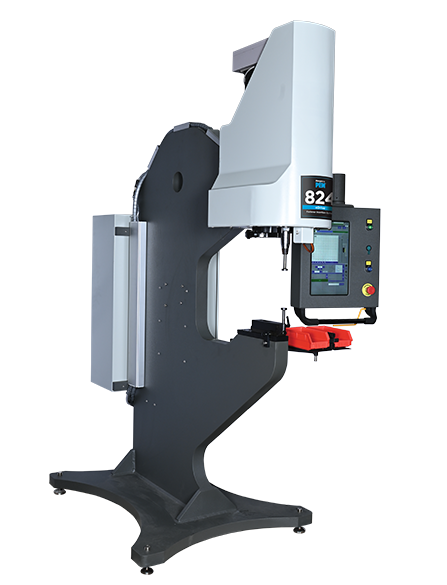
Take the Haeger 824 eDrive as an example: this servo-driven system delivers adjustable force from 2kN to 80kN with repeatability within 1% of force setting and 0.02mm of position setting. That level of precision allows a single machine to handle diverse requirements – from delicate electronic assemblies to heavy-duty automotive components – by simply adjusting software parameters.
Smart Manufacturing Integration
Modern servo machines integrate sensors for force, displacement, and position monitoring, logging process data for every cycle. This capability supports Statistical Process Control (SPC), enabling trend identification and documentation that’s essential for regulated industries and Industry 4.0 initiatives.
The 824 eDrive’s control system includes insertion graphics, fastener length detection, and fastener database capabilities as standard features.
Operational Advantages
Servo systems require less maintenance – no seals, cylinders, air valves, filters, or lubricators to service. They operate quietly without pneumatic exhaust noise and run clean without oil contamination risks. The controlled motion and force application reduces shock and wear on tooling, which extends tool life and lowers costs over the machine’s lifecycle.
Energy Efficiency
Servo technology delivers substantial energy savings. Testing shows that electric servo systems save 82% of energy compared to pneumatic booster machines, 75% versus conventional hydraulic machines, and 61% compared to servo hydraulic systems.
This efficiency comes from fundamental design differences. Electric servo machines draw significant power only when moving or under load – the 824 eDrive’s 5.3kW rating means it consumes energy during actual insertion cycles, not when sitting idle between operations.
Based on testing at 10 kN force with 72 kN clinching range machines, annual power consumption drops from 2,452.5 kWh (pneumatic booster) to 436 kWh. For high-volume operations, that translates to over 1,200 kg less CO2 emissions annually per machine.
When is Servo Technology a Good Fit?
Consider servo systems when:
- Low scrap rates and consistent quality are essential
- Operations handle multiple products with frequent changeovers
- Traceability and data capture are required for quality control or compliance
- Long operating hours make energy and maintenance savings significant
- Clean, quiet operation is important
- Precise insertion depth and force control are critical
- Smart manufacturing or Industry 4.0 initiatives are priorities
Hydraulic Technology: High-Force Specialist
Hydraulic insertion machines use pressurized fluid to generate linear force and controlled motion. This technology is particularly well suited for applications that demand high, sustained insertion force, such as thick materials, hardened substrates, or large self-clinching fasteners. Beyond force capability, hydraulic systems are widely valued for their exceptional durability and long operational life, often achieving service lifespans up to three times longer than pneumatic or electromechanical alternatives when properly maintained.
Power and Force Control
Hydraulic systems can generate and maintain very high force levels smoothly and predictably. Because hydraulic fluid is effectively incompressible, force delivery remains consistent throughout the entire insertion stroke. This characteristic is critical for fastening applications that require repeatable, high-load performance without force drop-off or variability.
Power and Force Control
Hydraulic systems can generate and maintain very high force levels smoothly and predictably. Because hydraulic fluid is effectively incompressible, force delivery remains consistent throughout the entire insertion stroke. This characteristic is critical for fastening applications that require repeatable, high-load performance without force drop-off or variability.
The controlled nature of hydraulic actuation supports:
- Uniform insertion quality
- Reduced risk of incomplete or inconsistent fastener placement
- Stable performance across long production runs
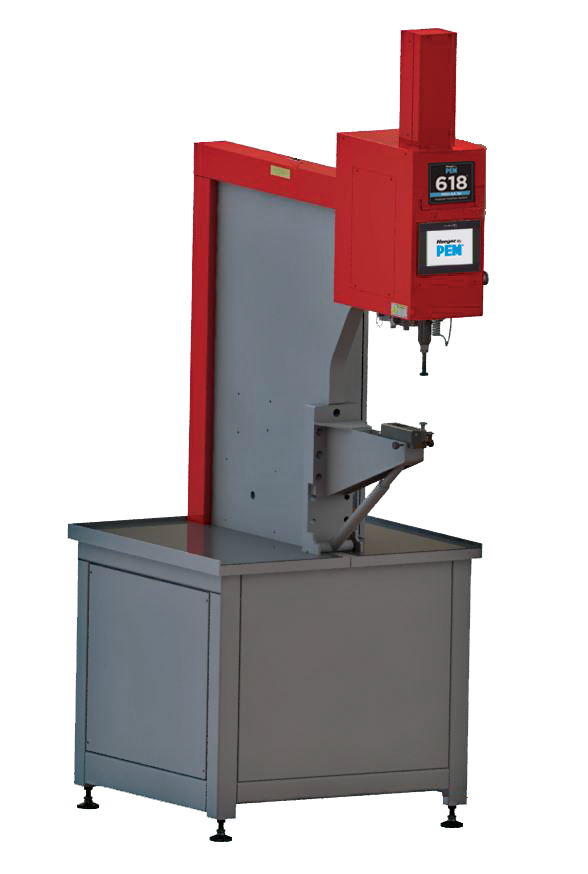
For example, the Haeger 618 PRO-AA features 6 tons (53 kN) of ram force with an 18” throat depth and an adjustable lower arm for maximum flexibility on complex sheet metal parts. The fully hydraulic design provides reliability, a patented safety system, tooling protection, and batch counting capabilities.
Long Life Cycle and Mechanical Longevity
One of the most significant advantages of hydraulic insertion machines is their exceptionally long service life, which is commonly two to three times longer than that of pneumatic or servo-driven machines in comparable production environments. This extended life cycle is driven by several inherent characteristics of hydraulic technology:
- Lower mechanical stress on drive components, as force is transmitted through fluid rather than high-speed mechanical or electromechanical linkages
- Slower, controlled motion profiles, which reduce shock loading and wear
- Robust, heavy-duty construction, designed for continuous industrial duty
- Proven component architectures (pumps, cylinders, valves) with decades of industrial validation
As a result, hydraulic insertion systems maintain accuracy and force capability over long periods with fewer performance degradations. This longevity directly reduces total cost of ownership by extending replacement intervals and maintaining productivity over many years of operation.

Proven Reliability for Demanding Production Environments
Hydraulic technology has a strong track record in heavy-duty manufacturing environments. The robust mechanical design can handle harsh production conditions reliably, making hydraulic systems a reliable choice when applications demand substantial force over extended production runs.
Considerations
Hydraulic systems require regular maintenance of fluid levels, seals, and pumps. They consume more energy than servo alternatives since pumps run continuously and not just during active cycles.
Facility considerations include managing hydraulic fluid, preventing leaks, and accounting for operational noise from the hydraulic pump.
When is Hydraulic Technology a Good Fit?
Consider hydraulic systems when:
- Applications require sustained high force for thick materials or large fasteners
- Long-term durability and extended machine life (often 3× longer than alternative technologies) are strategic priorities
- Proven, robust technology is preferred for demanding production environments
- Operations need reliable high-force capability without programmable precision requirements
- Existing facility infrastructure supports hydraulic equipment
Pneumatic Technology: Cost-Effective Workhorse
Pneumatic systems rely on compressed air to generate force and motion. Their straightforward mechanical design has made them manufacturing workhorses for decades, and they deliver dependable performance when their strengths align with operational requirements.
Simplicity and Reliability
The mechanical simplicity of pneumatic systems translates to straightforward operation and robust reliability.
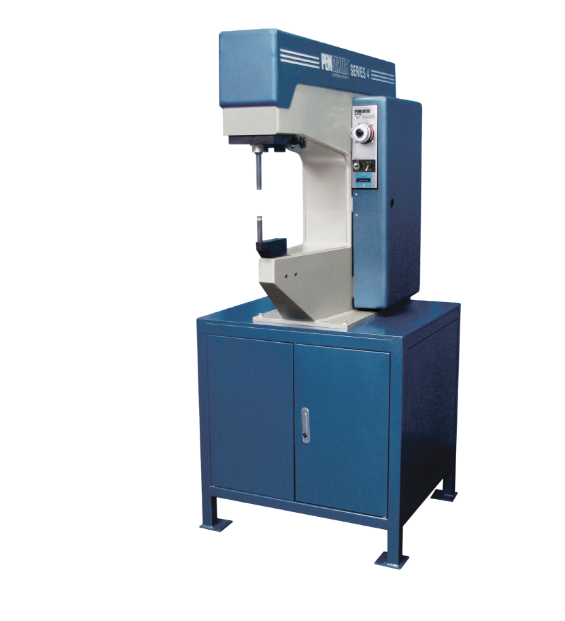
The PEMSERTER Series 4 demonstrates these strengths – delivering 12,000 lbs. (53.4 kN) of installation force with an 18” (45.7 cm) throat depth for consistency and simple operation.
The Series 4’s pneumatic logic system doesn’t need complex programming. Operators can quickly learn the controls and get production running efficiently. For facilities with experienced pneumatic technicians, the familiar technology means faster troubleshooting and repairs without the need for specialized training or software expertise.
Cost-Effective Entry Point
Pneumatic systems typically cost less upfront than servo or hydraulic alternatives, which is a key consideration for budget-constrained operations or companies establishing new production lines.
If your facility already has compressed air infrastructure, adding pneumatic equipment leverages that existing investment. The Series 4, for example, requires only shop air (90-100 PSI) with no electrical power beyond basic lighting.
Ideal for Stable Applications
For straightforward fastening operations that remain consistent – the same fastener installed the same way, every time – pneumatic systems provide dependable performance.
When production requirements are stable with minimal changeovers and applications don’t demand cycle-by-cycle data capture or precise depth control, pneumatic offers a smart solution.
The Series 4’s adjustable force range (400 to 12,000 lbs.) and 18” throat depth make it well-suited for larger workpieces and applications that benefit from substantial installation force.
Considerations
Air supply consistency affects performance repeatability, which makes shop air quality important.
Pneumatic systems consume more energy than servo alternatives and generate noise from air exhaust. They lack the programmability and data capabilities of servo systems, so they’re less suitable for operations that require detailed process documentation or frequent product changeovers.
When is Pneumatic Technology a Good Fit?
Consider pneumatic systems when:
- Existing compressed air infrastructure is already in place
- Initial investment cost is a primary consideration
- Operations are stable with consistent fastening requirements
- Applications require good installation force and throat depth
- Teams have existing pneumatic expertise
- Fastening applications are straightforward without requiring precise force modulation
- Proven, reliable operation with minimal training is essential
Making the Right Choice
The right fastener installation technology depends on your operational requirements and business priorities.
Each system has its own advantages – the key is understanding which capabilities matter most for your production environment.

Total Cost of Ownership
Initial purchase price is one factor.
Servo systems typically cost more upfront but deliver energy savings, reduced maintenance, lower scrap rates, and longer equipment life that can provide positive ROI within a reasonable timeframe – especially for high-volume or multi-shift operations.
Hydraulic systems fall between servo and pneumatic on initial cost but require ongoing maintenance of fluid systems and consume more energy than servo alternatives. Their value proposition centers around reliable high-force capability for demanding applications.
Pneumatic systems have the lowest entry costs and leverage existing infrastructure, which makes them cost-effective when their capabilities align with application requirements, and when advanced features aren’t necessary.
Energy Efficiency Comparison
Testing of hardware insertion machines with 72 kN clinching range at 10 kN force shows substantial differences in energy consumption:
Electric servo machines deliver:
- 82% energy savings vs. pneumatic booster systems
- 75% energy savings vs. conventional hydraulic machines
- 61% energy savings vs. servo hydraulic systems
For operations with sustainability commitments or carbon reduction goals, these differences represent measurable progress.
Annual energy consumption drops from 2,452.5 kWh (pneumatic booster) to 436 kWh (servo), which translates to over 1,200 kg less CO2 emissions per machine under high-usage conditions.
Your Strategic Decision
The choice among servo, hydraulic, and pneumatic fastener installation technologies is a strategic decision about matching capabilities to manufacturing needs:
- If you require precision control, programmability, data capture, and energy efficiency for complex operations with multiple product variants, servo technology delivers those capabilities.
- If you need reliable high-force performance for thick materials or large fasteners without traceability requirements, hydraulic systems provide that power.
- If you have stable, consistent fastening operations where simplicity and cost-effectiveness matter most, pneumatic systems offer proven reliability.
All three technologies have earned their place in manufacturing. Choosing the right one is a matter of understanding which capabilities match to your production goals.